


Three themes have dominated the investment landscape in 2026: continued investment in artificial intelligence infrastructure, the ongoing conflict in the Middle East and the related rise in energy prices, and, importantly for this article, rising developed-market bond yields. While rising yields have been a global phenomenon, we will focus on United States (US) government bonds.
For many investors, today’s interest rates, and as such, bond yields feel unusually high. But that is partly because the period following the Global Financial Crisis (GFC), between 2009 and 2020, was itself unusual.
During this time, central banks kept interest rates extremely low and bought back large quantities of government bonds and other securities through the process of quantitative easing (QE). This helped keep longer-term bond yields unusually low. In fact, investors had become accustomed to a multi-decade period of generally falling interest rates and bond yields. The post-COVID period, however, has been very different. The US 10-year Treasury yield fell as low as 0.31% in March 2020 but has since risen sharply, signalling a major change in the US interest-rate environment.
Why do bond yields matter?
When governments need to borrow money, they issue bonds to investors. The yield on a government bond reflects the return investors require to lend money to that government. Government bond yields, however, matter well beyond the bond market because they influence borrowing costs across the economy. Mortgage rates and corporate borrowing costs, for example, are influenced by government bond yields. Bond yields also influence the rates investors use to value other assets, including equities.
One important relationship is worth remembering: when bond yields rise, bond prices fall, and when yields fall, bond prices rise.
Higher yields are not necessarily bad. They can result from concerns about inflation or the level and quality of government debt, but yields can also reflect a stronger economy that is consistent with higher interest rates. For investors buying bonds at today’s higher yields, this also means getting a higher return on their investment than when yields are lower. What matters is why yields are rising, how quickly they rise, and where they sit relative to inflation and economic growth.
Why are US bond yields rising?
The easiest way to understand the change is to compare the world before and after COVID.
Following the GFC, the US Federal Reserve (Fed) used very low interest rates and large-scale bond purchases to support the economy. Inflation also remained subdued, allowing interest rates and bond yields to stay unusually low for an extended period.
When the COVID pandemic struck, that backdrop was fundamentally changed. Governments responded to the pandemic by spending heavily and running large budget deficits. Increased fiscal spending can have a faster and more direct effect on economic demand than monetary stimulus and, particularly when an economy is supply-constrained, can cause a rise in inflation, which is what happened.
Another important change following the pandemic was that there was less excess saving in the global financial system than after the GFC. Governments were borrowing more, households and companies were no longer paying down debt as aggressively, and changes in global trade reduced how much money was being pushed into Western bond markets. With less money available to meet greater borrowing needs, interest rates had to rise in order to attract and compensate lenders.
In addition, inflation, which had already accelerated sharply through 2021, was worsened with Russia’s invasion of Ukraine in early 2022, which added further pressure through higher energy and food prices. To counter this, the Fed responded by raising interest rates aggressively. As investors realised that inflation would be more persistent than initially expected, they revised their expectations for future interest rates higher. Longer-term bond yields rose accordingly, while investors also began demanding higher yields to compensate for greater uncertainty around future inflation and government finances.
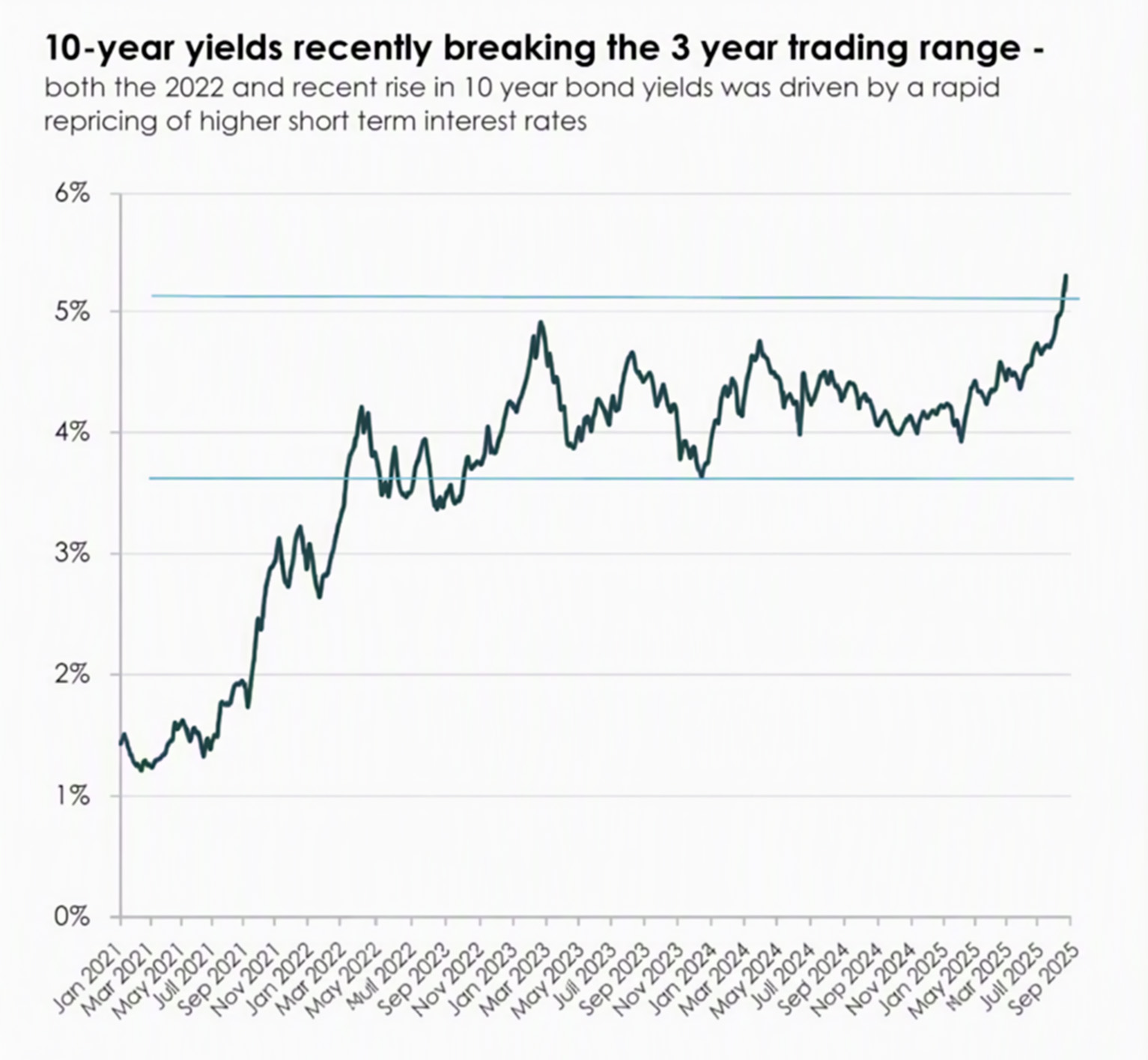
After reaching around 5% in October 2023, the US 10-year Treasury yield traded broadly below that level for the following three years. Its recent move above 5%, reaching around 5.25% in early October 2026, represents a significant break from that range.
What is driving the latest move?
More recently, the rise in yields has been driven largely by changing expectations about monetary policy and its ability to combat inflation. Strong US economic growth, inflation that remains above the Fed’s target range of 2%, and persistently higher energy prices, which are a key driver of inflation, have reduced confidence that the Fed will be able to lower interest rates as quickly as investors previously expected. A 10-year bond is influenced by where investors expect interest rates to sit over its lifetime. So, when investors expect rates to stay higher for longer, the 10-year Treasury yield tends to rise to match those rates, see Graph 1.
Importantly, higher yields do not simply mean that investors are becoming more concerned about US government finances. Strong nominal economic growth, which includes both real growth and inflation, is also consistent with higher levels of interest rates. Government finances nevertheless remain part of the story. Persistent budget deficits generally require substantial government borrowing, increasing the supply of Treasury securities that private investors must absorb. All else being equal, this can put upward pressure on the yields investors demand.
Encouragingly, investors do not appear to be expecting inflation to spiral out of control in the long term. Instead, they are demanding a higher return after allowing for inflation, which is reflected in significantly higher real yields.
Put simply, higher energy prices and a more hawkish Fed, meaning a Fed more inclined to keep interest rates high, help explain the latest rise in yields. Larger government deficits, less excess global saving and the end of QE help explain why the longer-term level of interest rates is likely to be higher than it was in the decade following the GFC.
While yields above 5% may feel extreme to investors conditioned by the post-GFC era, they are not particularly unusual when viewed over a longer period and are broadly consistent with periods of stronger nominal growth, such as the late 1990s and early 2000s.
What does this mean for portfolios?
Higher yields have made US government bonds more attractive.
In our assessment, fair value for the US 10-year Treasury yield is somewhere around 4.5%, broadly consistent with where we expect longer-term nominal US GDP growth to settle. Following the recent weakness in bond markets, we believe the case for remaining significantly underweight US government bonds has weakened. Our preference is to move towards a more neutral position and potentially add further exposure if yields rise from here.
There is also considerably more income available from bonds today. The higher starting yield provides more income to offset some of the capital loss that would occur if yields were to rise further.
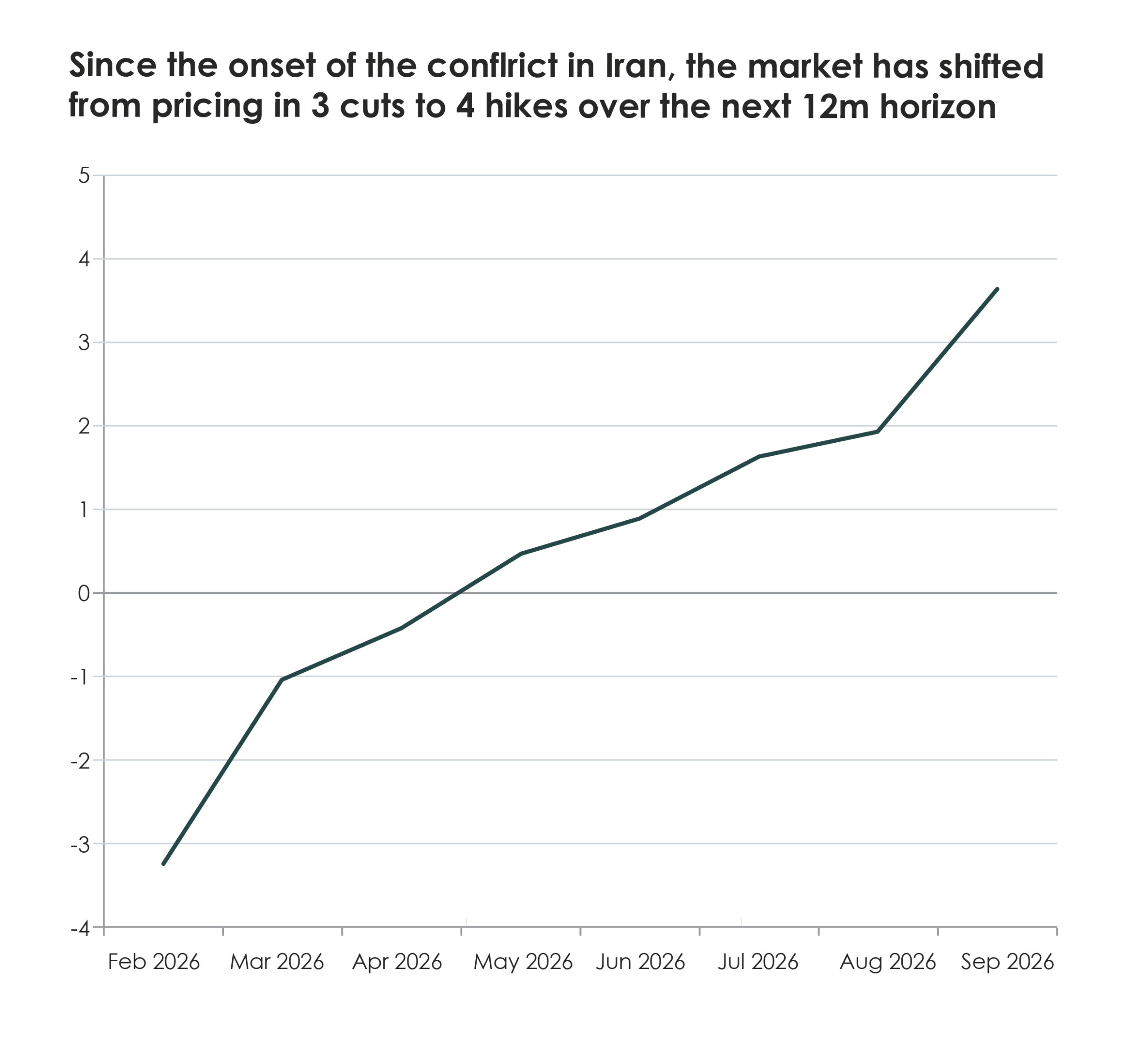
That does not mean we expect an immediate bond rally. Energy prices remain high, the Fed remains focused on inflation, and nominal economic growth remains strong. These factors support the Fed’s current hawkish stance. For bonds to rally meaningfully, investors will probably need to expect fewer interest-rate increases or eventually begin anticipating rate cuts. Our view is that markets may currently be pricing an overly aggressive path of interest-rate increases over the next 12 to 18 months. A normalisation of this pricing would be bond positive, see Graph 2.
For now, equities remain our preferred asset class while the current economic environment persists. At the same time, portfolios remain diversified across other assets, such as gold, hedge funds and managed-volatility strategies, where appropriate. If economic conditions begin to weaken, US government bonds should become increasingly valuable as a defensive asset in portfolios.


